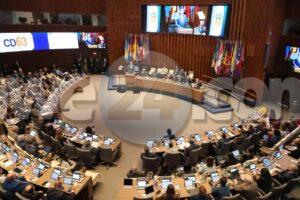
PAHO regional meeting of health ministers concludes with new measures to strengthen health security and address key health threats
Health authorities approved new regional strategies to strengthen preparedness for health emergencies, tackle antimicrobial resistance, curb dengue and other arboviral diseases, and improve food safety, while advancing access to vaccines, medicines and other essential health technologies across the Americas.
Washington, D.C., 2 October 2026 (PAHO) – The 63rd Directing Council of the Pan American Health Organization (PAHO) concluded with countries of the Americas approving a series of decisions aimed at strengthening preparedness for increasingly frequent health emergencies, addressing antimicrobial resistance, reducing the growing burden of dengue and other arboviral diseases, improving food safety, and expanding access to health technologies.
Over five days, Ministers of Health and other senior health authorities from across the Americas met in Washington, D.C., to discuss key public health priorities, review progress on regional initiatives and adopt decisions aimed at strengthening health systems and advancing health and well-being across the Region.
“The resolutions and decisions adopted during this Council will guide our work in the years ahead. But their true value will not be measured by what was approved in this room. It will be measured by what changes in the lives of the people we serve,” said PAHO Director Dr. Jarbas Barbosa.
The strategy comes as the Americas face increasingly frequent disasters, outbreaks and other health threats. Between 2021 and 2024, nearly 30% of all disasters recorded worldwide occurred in the Region.
Member States also approved the Plan of Action on Antimicrobial Resistance 2027–2031, which promotes a One Health approach and seeks to strengthen surveillance, laboratory capacity, infection prevention and control, appropriate use of antimicrobials, and access to diagnostics and vaccines.
The strategy was adopted following the largest dengue epidemic on record in the Americas. In 2024, countries reported more than 13 million dengue cases and over 8,400 deaths across the Region.
A new Strategy and Plan of Action on Food Safety 2026–2031 will support countries in strengthening food safety systems, surveillance, laboratory services and risk-based approaches to reduce foodborne diseases and improve coordination across sectors.
The new framework addresses a significant public health challenge in the Americas, where foodborne diseases affect an estimated 43.7 million people and cause around 78,000 deaths each year.
Strengthening access to health technologies
Countries also advanced efforts to strengthen and modernize PAHO’s Regional Revolving Funds, which support access to vaccines, medicines, diagnostics and other essential health technologies.
“These mechanisms allow countries to continue expanding access to vaccines, medicines, diagnostics and other essential health technologies that save lives every day in our Region,” Dr. Barbosa said.
The changes seek to make the Funds more efficient, flexible and sustainable while maintaining pooled procurement as an important mechanism for improving access to quality-assured health products at affordable prices.
Over the last biennium alone, PAHO’s Regional Revolving Funds helped protect an estimated 170 million people through pooled procurement and shared financing mechanisms.
Advancing health across the Americas
The 63rd Directing Council also addressed priorities including disease elimination, primary health care and digital health, while providing a platform for countries to share experiences and solutions to strengthen health systems.
During the week, PAHO presented a new edition of Health in the Americas, which found that nearly 40% of the Region’s disease burden could potentially be avoided through stronger prevention, earlier diagnosis and treatment, and more effective health systems.
The Council also recognized disease-elimination achievements over the past year in Brazil, Chile, El Salvador, The Bahamas and Turks and Caicos Islands, including landmark advances against HIV, leprosy, trachoma, rabies and hepatitis B, underscoring the progress that can be achieved through sustained political commitment, strong health systems, scientific evidence and regional cooperation.
PAHO also marked the 50th anniversary of its Emergency Program, recognizing five decades of support to countries in preparing for, responding to and recovering from some of the most complex health emergencies faced by the Region.
Beyond the deliberations of the Directing Council, the week also included the 78th Session of the WHO Regional Committee for the Americas, where health authorities discussed global and regional health priorities, including the future financing of global health and WHO’s work across the Region.
Speaking virtually, WHO Director-General Dr. Tedros Adhanom Ghebreyesus highlighted the Americas’ progress in health emergency preparedness, disease elimination, digital health and regional cooperation, pointing to PAHO’s Regional Revolving Funds as one of the world’s most successful examples of solidarity in action.
He noted that these achievements “reflect political leadership, the commitment of health workers and communities, and the enduring value of regional cooperation.”
“Throughout this week, we have seen once again that the diversity of our Region is one of our greatest strengths. No country has all the answers. But together, we possess an extraordinary wealth of experience, expertise, and creativity,” Dr. Barbosa said.
“As we leave this meeting, let us keep the dialogue alive, exchanging ideas, learning from one another, and engaging in the constructive debate that strengthens our decisions and our institutions,” Dr. Barbosa said.
The decisions adopted this week are expected to strengthen the Region’s ability to prevent and respond to health threats, expand access to health technologies and advance stronger, more resilient health systems across the Americas in the years ahead.